
Art as joke
Doing for your own amusement

I recently finished Ulysses, about which Joyce said:
I've put in so many enigmas and puzzles that it will keep the professors busy for centuries arguing over what I meant, and that's the only way of insuring one's immortality.
One of its recurring puzzles is an insult postcard marked “U.P.”, a joke which every character seems to be in on minus the reader. Other odd fixations include a bar of soap the protagonist carries around, a stranger wearing a Mackintosh, and the pronunciation of the word metempsychosis.
I tried to imagine what motivated Joyce to make it so difficult. What attitude would he have had while writing it? Because I don’t believe that anyone would dourly set out to write an epic, I assume that the work is simply very funny to him.
As a failed Jesuit, an impoverished lover of the classics, and an Irishman living in Italy, Joyce is tangled up in contradictions that deserve some humour. And the ridiculousness of his identity is expressed in the book’s form. Ulysses is notable for mingling the sacred with the profane, banality with mythology, nationalism with provincialism. Stephen Daedalus (Joyce) is alternately interpellated by British rule, Greek mythology, the Catholic theology, and Irish culture. Leopold Bloom is cleaved along similar lines, but he is by ancestry a Hungarian Jew—an outsider with a pointedly materialist outlook on the world.
One chapter details a bigotted Irishman chasing Bloom out of a bar—recounted as a heroic scene from Ireland’s halcyon days. Another takes place in a maternity ward, drawing comical parallels between medical students loudly debating abortion and the slaying of Helios’s sacred bull which is simultaneously the mythical bull of Ireland. The longest and most elaborate follows Bloom and Stephen in the red light district, where they enter a brothel interpreted as Circe’s island. There, a procession of nymph prostitutes, acquaintances, public figures, and past family put Bloom on trial—with his marital fidelity and Irish identity at stake.
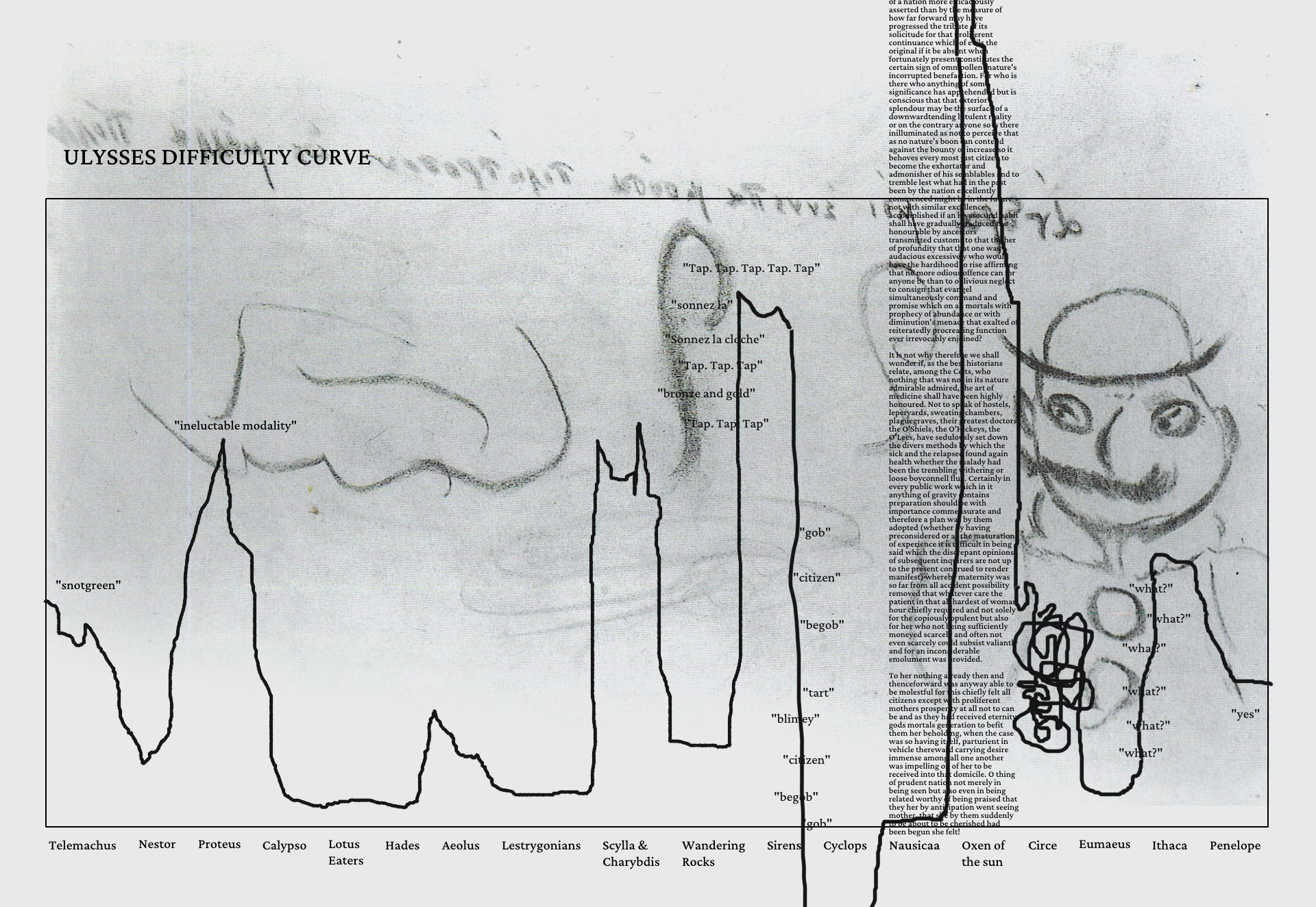
Throughout the book Joyce is able to entertain himself by continually upping the ante with these absurd juxtapositions. Once you get to Oxen and Circes he has gone well beyond what the reader can reasonably appreciate. And we know from Finnegan’s Wake that Joyce got lost in his games. Still I suspect he wrote with his own amusement in mind, and if he was obtuse then he enjoyed being obtuse while imagining his future readership.
Understanding authorial intent as an inside joke rather than a skeleton key frees me to enjoy the work even when I don’t understand it. It also leads me to believe that to make art over any long period of time there needs to be a jocular component to its composition—no matter how serious the material is.
I rarely find a classic that is as ponderous as its reputation— except for Dostoyevsky who seems completely joyless. In Moby Dick, Melville concocts a haughty version of himself, narrating in grandiloquent biblical style a life expereincethat was likely unbearable. Dante imagines himself in conversation with great historical figures, friends and enemies, palling around with Virgil. In Metamorphoses Ovid plays with Greek transformation myths, furnishing them with lively new interpretations. Wikipedia quotes a critic to say “Ovid approached [Greeky myths] as an object of play and artful manipulation.”
Right now I am reading the Beckett Trilogy and it is equally hilarious and impossible. Even if I’m not in the know I can still appreciate that a game is being played. Whether it is on me, Beckett, or on art itself, if the joke lands is less important than the outcome: a work which is richly invented and singular.